Friday, September 20, 2013

Jody Hedlund's "Rebellious Heart" - when should we rebel, and when should we submit?

Rebellious HeartBased on the courtship of John and Abigail Adams, Jody Hedlund's Rebellious Heart is a beautiful romance set amongst the first rumblings of rebellion prior to the American Revolution, when the British were abusing their authority over the colonists and cracking down on their laws of importation.  Benjamin Ross is a poor country lawyer, the son of a farmer, lacking the wealth and good birth needed to improve his reputation.  The younger daughter of a well-to-do clergyman, Susanna Smith improves her mind the best she can on her own, unable to have the education she desires - the education her younger brother takes for granted.  Ben and Susanna do not get along very well, as he thinks she's snobbish and she disagrees with his traitorous politics.  However, when Susanna finds a young woman in need of help, she feeds, clothes, and hides her, even though she is clearly runaway indentured servant, and therefore illegal to help.  Trying to find a way to protect Dotty from her cruel master, she turns to Ben for legal help, which introduces them to an unexpected friendship and places them in a dangerous game of keeping one step ahead of the man chasing Dotty. 

While Ben and Susanna are first friends before they are lovers - enjoying matching wit, debating politics, and working together to rescue Dotty - the author does an excellent job at creating an ever-present romantic tension between them.  Their friendship, though, is what holds them together while Ben is still pursuing another woman and Susanna is caving to her parents' preference.  It is a slow route to love, and certainly not without trials and stumbling blocks, but it is a sweet romance and solid basis for a relationship. 

One of the biggest issues in the book - and it is one that has probably plagued Christians since Paul first wrote about it to the Romans (if not since Jesus provided the ultimate example) - is the command to be subject to the authorities, for God has placed them over us.  But what is one to do when the authorities abuse their power?  How far should one go before one says "enough!"? 

Even though in New Testament times the authorities of the temple not only allowed but encouraged moneychangers and the sale of animals for sacrifice in the temple courts!, Jesus came twice and chased them out - once at the beginning of His ministry, and once just before they crucified Him.  God made the temple a place for worship, to honor Him, not to provide a lucrative business for the corrupt leaders.  As Jesus proved, ultimately, God's authority trumps man's authority - sometimes, to honor God, we must break from the authority of sinful man.  

In Susanna's case, her decision essentially comes down to this - which is worse: to be brought before the courts for showing compassion, or to stand before God in the judgement and answer why she failed to help those in need?  Her heart leads her to the right decision, even if her mind balks at the thought of the consequences.  Jesus says in His word, "Behold, I send you out as sheep amidst the wolves.  Therefore be wise as serpents and harmless a doves" (Matt 10:16).  In protecting Dotty, Susanna is compassionate, harmless, and if anything, righting wrongs - but to elude the Wolf, she and Ben must be wise as serpents. 

Hedlund has written an excellent novel - not only is the plot thrilling and the romance sweet, but she has imbedded so much to ponder spiritually.  We may not be on the cusp of revolution ourselves, but the tension with authority still bothers us today, whenever officials fail to choose the godly path or their corruption would have us join them.  Thankfully, Jesus says, "all authority has been given to me in heaven and on earth," so we can always appeal to His higher authority when our leaders fail.  5 out of 5 stars! 

Thank you to Bethany House for providing a free copy of this novel for the purpose of review; I was not required to make it positive, and all opinions are my own.  

Wednesday, September 18, 2013

"The Quaker and the Rebel" by Mary Ellis

The Quaker and the Rebel (Civil War Heroines, #1)In the first of her series of Civil War Heroines, Mary Ellis pits an abolitionist Quaker maid against a Rebel leader of a band of rangers.  Having no family left, Emily Harrison agrees to be a governess in the Bennington household in Virgina, making it clear that her Quaker convictions cannot abide slavery.  When her charges are sent to Europe for safety, Emily stays on as a companion to the lady of house so that she can aid slaves through the underground railroad.  Alexander Hunt, nephew of Mrs. Bennington, has fallen far from the Quaker ideals his mother imparted in his youth, though he refuses to harm or kill in his role as the Grey Wraith, the leader of a band of gentleman who plague the Union by stealing their goods.  In spite of strongly differing opinions with Emily and the danger he flirts with in pursuing a Yankee, he finds himself falling for her.  Can two people so firmly on opposite sides of the war fall in love without compromising their convictions?

For a Quaker, a person of peace and simplicity, Emily is extremely strong-minded, apt to lose her temper, and tempted toward vanities - she likes pretty dresses, a touch of make-up, and a bit of male attention.  She is quick to judge the Benningtons and Hunts as evil for keeping slaves, even under much fairer and more positive conditions than much of the South, yet she promptly lies to them and uses them to further her own ends, not to mention judges them (and does so unfairly).  Given her tendency toward bigotry, an apt verse for her would be, "How can you say to your brother, 'let me remove the speck from your eye,' and look, a plank is in your own?  Hypocrite!  Remove first the plank from your own eye, and then you will see clearly to remove the speck from your brother's eye" (Matt 7:4-5).  She has far to go to realize the kindness and goodness in her employers.

Given that Emily and Alexander are firmly planted on opposite sides of the war, I could not anticipate how they were going to compromise enough develop a relationship in the first place, let alone forge one strong enough to survive the war.  Both Emily and Alexander are stiff with pride; she is strongly prejudiced against the South and he against the North, and though they both agree that slavery is wrong, they disagree on how to abolish it.  However, they both grow - Emily out of her bigoted idealism, and Alexander out of the dissipated lifestyle into which he had fallen. 

The story grew on me.  At first I was frustrated with both of the main characters - Emily especially - but as the plot increases in danger and excitement and they learn to set aside their prejudices, they improve remarkably.  Since neither the North nor the South embodies "good" or "evil," and since neither character is secretly working on the same side as the other, I could not anticipate what the outcome of the story would be, other than supposing that the two would find a way to compromise and fall in love and knowing that the Union would ultimately win.  Would Alexander abandon his role as the Grey Wraith to be with Emily?  Would he join Emily in helping slaves to freedom?  Would Emily get herself caught while freeing slaves?  Would battle catch up with them and strike them with the deaths of friends and family?  It is nice to read a novel in which the plot could go so many different ways that one cannot expect what is to come.  3.5 out of 5 stars. 

Thank you Harvest House and Netgalley for providing a free, advance e-copy for the purpose of review.  I was not required to make it positive; all opinions expressed are my own.

Monday, September 16, 2013

Kathleen Y'Barbo's "Sadie's Secret"

In Kathleen Y'Barbo's third novel of The Secret Lives of Will Tucker, we discover there isn't just one William Tucker - there are two, the identical twins William Jefferson and William John.  Upon being released from a year of wrongful imprisonment, it could be said that British detective William Jefferson Tucker has some unresolved issues with his criminal twin brother, especially since John deliberately put him there in the first place after managing to convince the powers that be that Jefferson was the real criminal and he (William John) was the innocent.  Pretty Pinkerton agent Sadie Callum knows the truth, so she springs Jefferson, but she is mighty tired of being on the Tucker Case when what she really wants is to be on a case involving international art fraud.  However, soon it appears that two are mixed up somehow - is it only because Jefferson was the British agent on the case before he was incarcerated?  Or are he and John really in cahoots, trading off on their good twin/bad twin reputation to swindle them all?

Sadie's Secret (The Secret Lives of Will Tucker, #3)Once again it is Y'Barbo's talent with spectacular secondary characters that really makes the book.  Sadie's father, her mother, her Uncle Penn - there's more to each of them than meets the eye.  Even the bit parts, like Jefferson's spunky granny, play an important and memorable role in the plot.  Considering that Sadie has five brothers and that they are relatively minor characters, I was impressed by how distinct the author was able to make them - they were definitely individuals, not just a unit. 

One overarching theme of the series is the importance of family, and it is the pivot point for the main characters in this book.  No matter how annoying, meddlesome, or untrustworthy they are, one always wants to believe the best in one's family, to give them a chance to do things right.  As much as Jefferson believes his brother deserves to be in jail - and he is more than willing to put him there himself - he still falls for his brother's cons, always hoping that he'll finally choose the path of right.  Sadie has a wonderful family; in spite of their overprotective,  meddling ways, you can tell how much they love her, and just how much she loves and respects them back.  Even though she often feels hemmed in by them, and though she does not always agree with them, their opinions factor heavily in her decisions. 

While I very much enjoyed the first two of the series, this one was my favorite.  Watching two detectives practice their trade on each other to worm out information and manipulate behavior was quite amusing.  Much of the story is fun and romantic, but there is also discussion of serious topics, and a time in which my eyes did not remain precisely dry.  It is a novel not of revenge, but of truth, trust, and restoration. 

Thank you Harvest House and Netgalley for providing a free, advance e-copy for the purpose of review.  I was not required to make it positive; all opinions expressed are my own.


The Secret Lives of Will Tucker begins with Flora's Wish, followed by Millie's Treasure, and is concluded in Sadie's Secret. 

Friday, September 13, 2013

"Millie's Treasure" by Kathleen Y'Barbo

In Kathleen Y'Barbo's novel Millie's Treasure, which follows Flora's Wish in the series of The Secret Lives of Will Tucker, Will Tucker is once again out of jail and pulling his finacé scam on wealthy young women, swindling them out of their jewels; this time, his eyes are set on Mildred Cope, the bluestocking daughter of a southern gentleman.  Millie's father is not the most pleasant of men - in fact, she is planning on marrying her Sir William Trueck for the sole purpose of escaping her father, who has forbidden her studies in cryptology and other scientific research.  Pinkerton agent Kyle Russell has been momentarily pulled off of the Will Tucker case to search for lost Confederate gold, and while experimenting with his latest invention encounters the lovely Millie.  Though off to a mildly rocky start, they forge a bond over their love of science, and Millie has a puzzle she needs Kyle's help to solve.  Despite what Kyle's heart tells him, he cannot be sure of the lovely southern belle - is Millie connected to the missing treasure?  And has she joined forces with the notorious Will Tucker to find it?


Millie's Treasure (The Secret Lives of Will Tucker, #2)
This is not your typical historical novel; though the setting is well researched regarding time and place, it actually borders on fantasy, based on legend rather than historical fact.  The tales surrounding Jean Lafitte and his treasure are fascinating; I had no idea that there were connections (tenuous though they may be) between Lafitte and the stories of hidden Confederate gold.  Even if it is not necessarily how history went, it is fun to hear them and wonder how close they are to the truth.  The steam punk aspect - the inclusion of inventions that have not yet been patented and quite possibly not completely invented - also adds to the fantastic feel of the novel.  Really, how romantic would it be to have the gentleman of your dreams appear in your window, ready to whisk you off on a romantic flight beneath the stars?

While it is a light-hearted novel,  Millie's Treasure does touch on a couple serious issues - Millie's father, wracked by grief and guilt, has pulled away from his only surviving child, feeling guilt for her mother's and sisters' deaths every time he looks at her, afraid to show his love.  Millie must fight to find a way to be herself in a society and under the authority of those who disapprove of her interests and desires.  It is a fun, clean, read, full of romance and adventure.  4 out of 5 stars

Wednesday, September 11, 2013

"Fired Up" by Mary Connealy

Fired Up in her Trouble in Texas series picks up right where Mary Connealy left off in Swept Away.  Dare Riker, self-proclaimed doctor based on his experience patching people up in Andersonville prison during the Civil War, still has a thing for the lovely Glynna Greer, who, recently widowed from her abusive polecat of a husband, rather likes him back.  The problem is, she's had two bad husbands in a row, and her two children, her maturing son Paul especially, are not keen on a third.  In fact, Paul has threatened Dare's life on occasion, which might not normally be taken seriously, except that there is that man-made avalanche that almost killed him, followed by a fire, and topped by a stabbing.  All this on top of Glynna's cooking at her diner, which, while it hasn't actually killed anyone yet, has significantly increased Dare's doctoring business.  Can Dare live long enough to make peace with the kids so Glynna will marry him? 

Fired UpOne of the best but hardest parts of this story is the relationship between Dare and Paul.  Dare is trying to teach Paul that there are good men in the world who respect women, men, and children alike; in an effort to be a good role model, he tries to spend more time with Paul by inviting him hunting, encouraging his help with his doctor practice, and generally including him with the men.  However, every step forward seems to end right back where he started, with an angry, sullen young man.  Paul is very protective of his mother; when he sees that Dare likes his mother, he feels like Dare's overtures of friendship are just a ploy to get at his mom, so he again hardens his heart against him.  Dare is a good example of what a man should do in the situation: he is friendly and makes an effort to include Paul without forcing him one way or the other, but he doesn't hesitate to lay down the law when he needs to.  That strength to say no, to temper discipline with compassion, while unappealing to Paul, is, I think, what will eventually lead to a good relationship between the two. 

I like - but am a bit frustrated - that Connealy has set up the next book in the series by giving a little more background on Vince and introducing Jonas' reforming sister Tina.  It's fun to get a taste of the next book, but if only it were not so long until it comes out!  There's a bit less talk of God in Fired Up than in many of Connealy's previous novels - it is basically limited to some discussion on forgiveness at the end - which was a little disappointing.  However, like usual, she writes a great comedy.  This one has a bit more mystery than usual, since it is anyone's guess who is trying to bump Dare off.  A highly amusing book!  4 out of 5 stars

Thank you to Bethany House for providing a free copy of this novel for the purpose of review; I was not required to make it positive, and all opinions are my own.

Trouble in Texas
Prequel: "Closer than Brothers: Surviving Andersonville" (novella)
1. Swept Away
2. Fired Up
3. Stuck Together

"Runaway Bride" (follows Trouble in Texas and Kincaid Brides series; from the novella collection With This Ring?)

"The Tangled Ties that Bind" (follows Trouble in Texas and Kincaid Brides series; from the novella collection Hearts Entwined)

Monday, September 9, 2013

Olivia Newport's "The Invention of Sarah Cummings"

The Invention of Sarah CummingsSet in 1890's Chicago, Olivia Newport's The Invention of Sarah Cummings follows a young parlor maid as she invents for herself a role in upper class society.  Orphaned as a child and sent into service as a teenager, Sarah has become an accomplished seamstress but longs for a life of ease.  In a spur of the moment decision, Sarah invents for herself a new name - Serena Cuthbert - along with a full, affluent past to sneak her way into society and a wealthy marriage.  However, her new life still has to be sandwiched in between her duties as a maid and her obligation to teach sewing classes for the girls at the orphanage where she grew up, and it becomes harder and harder to keep her servile life secret from her friends and beau in society. 

I do not completely dislike Sarah, but due to her choices and the motives behind them, it is also hard to actually like her.  If there were anything noble about her deception, it would be easier, but it is purely for her own personal gain that she passes herself off as a socialite.  Creating, owning, and wearing fancy dresses is acceptable; creating a false life with the full intention of perpetuating it through marriage is not.  I also had a hard time understanding her fantasy - she can appear to be a wealthy lady by her dress and talk, but the moment they find out the truth, where will she be?  Back to being just a maid, quite possibly sacked, and likely branded a liar.  In the city where she was born and raised, where acquaintances abound, there is too miniscule a chance of pulling off her deception even long enough to become engaged, let alone marry. 

Newport writes an incredibly rich historical novel, in which clearly a significant amount of research was involved.  Invention involves a lot of the political history of the time, including the William McKinley vs William Jennings Bryan debates and presidential election, at a time when America was moving toward leaving the gold standard for currency.  Her take on the upstairs-downstairs roles is also well written, and in spite of Sarah's blurred view of the lines, it is still clearly a very real divide -  the wealthy can choose to "work" by occasionally helping with charities, but they are not friends with nor do they marry those of the working class.  Newport's appreciation for the perfection involved in service comes through in Sarah's tendency to notice the hard work of other servants while she is pretending to be Serena Cuthbert. 

The novel was not exactly what I had anticipated.  Having never read any of Newport's novels before, I was expecting something a little more lighthearted and romantic, based on the title and description; this, however, is decidedly on the reserved side, with a greater emphasis on the history than the romance.  Since the relationship between Sarah and Simon is not a strong focus of the book, it seems a bit rushed in the end when Sara is finally willing to take a chance on him.  Also, I am uncertain as to whether or not she learns anything spiritually; she learns to accept herself and chooses to make things right with Simon, but I do not feel she is any closer to God personally at the end of the book than at the beginning.  Given that, along with how difficult it was to care for the main character, I give this book 3 stars.  While it is the third book of a series, I had no problem following the story.  I would still like to read the first two novels of the series, though, as I liked the writing style and strong historical basis. 

I received a free e-copy of this novel from Revell via Netgalley for the purpose of review; all opinions expressed are my own, and I was not required to make my review positive.


Avenue of Dreams
The Pursuit of Lucy Banning
The Dilemma of Charlotte Farrow
The Invention of Sarah Cummings


Friday, September 6, 2013

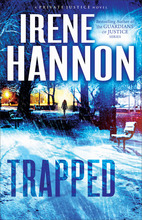
Irene Hannon's "Trapped" - true suspense!

TrappedWow.  Talk about suspense.  Irene Hannon's Trapped is not a mystery-suspense, where some of the thrill is watered down in distracting the reader with red herrings until the final coup reveals the villain; this is a hard core, Alfred Hitchcock-style thriller, where we are privy to everything that is going on - from the villain's thoughts to the victim's to the detective's to that of the girl being used by the villain - watching seemingly innocent actions twist into something both terrible and terrifying.

Hannon's tale begins with the disappearance of Laura Griffith's sixteen-year-old half-sister, Darcy, who, fed up with rules, takes off into a winter storm leaving behind only a short note to say that she has gone.  Not getting the response she wants from the local police, Laura turns to Phoenix Inc, a private investigative agency run by three men formerly in law-enforcement, including James Devlin, ex-ATF agent.  Dev is quite taken with Laura, and, knowing how quickly teens on the street end up in prostitution and drugs, he throws himself into the investigation, hoping the multi-day storm is enough to keep Darcy from escaping St. Louis, at which point her chances of being found would grow notably slimmer. However, as the days stretch on, the trail grows colder, and their suspicions grow stronger that something sinister has happened to her. 

While the description of the book leads one to believe that Dev and Laura are the focus of the novel, it is actually through Darcy's and the villain's point of view that we see most of the suspense.  Without them, it would be a long, boring search (and just another mystery-suspense cross) before the intense finale.  Hannon, however, weaves the suspense surrounding Darcy with the romance and tough PI work of Dev and Laura to form a well balanced novel.  It starts out ominous and builds steadily from there, not remotely suffering from the middle-of-the-book-slump that so often plagues the genre. 

Like Hitchcock's tradition of interspersing humor to cut the tension periodically and thus intensify the suspense without overdosing the audience, Hannon includes plenty of ribbing and good natured banter between employees of the Phoenix Inc, being a company formed by good friends.  The developing romance, too, provides relief and a necessary humanity to the novel so that we care what happens to Dev and Laura (in addition to Darcy, with whom our sympathies instinctively lie, being the victim); we see their motivations, their regrets, their uncertainties, and we watch them break down walls that they had erected over the years.  In Darcy we see the most change: from a defiant youth to a broken, frightened girl, crying out to God, to an imperfect but loving sister who no longer takes life for granted. 

While I have enjoyed all of Hannon's books, this one has surpassed them all, reaching even beyond what I expected from Hannon's expert hand at the genre. While the romance may happen incredibly quickly and the Christian message be not as strong as in other novels, this is a clean, supreme example of what a suspense should be.  5 out of 5 stars!

Thank you Revell and Netgalley for providing me a free e-copy of this novel for the purpose of review; I was not required to make it positive.  

Private Justice
1. Vanished
2. Trapped
3. Deceived