Showing posts with label Early 1800's. Show all posts

Wednesday, December 7, 2022

All the Lost Places by Amanda Dykes

Discovered floating in a basket along the canals of Venice, Sebastien Trovato wrestles with questions of his origins. Decades later, on an assignment to translate a rare book, Daniel Goodman finds himself embroiled in a web of secrets carefully kept within the ancient city and in the mystery of the man whose story the book does not finish: Sebastien.

One thing that can't be disputed, Amanda Dykes has a beautiful, lyrical writing style, and it's exceptionally suited to this almost fairy-tale-like book of stories within a story. Straightforward it is not, especially the translation of the Book of Waters (aka the past timeline of this dual-timeline book), but given that Venice--a tangled web of canals and streets, islands and bridges--is nearly a character in and of itself, it seems fitting that the story would reflect the setting. 

Of the two timelines, at first I preferred Daniel's story, which, even with his complex task, is the simpler one. He's relatable; a man who has messed up, who's trying to reclaim a lost part of himself, and who, prodigal that he is, is ashamed to go home. Vittoria is a delightful whirlwind that blows into his life and turns it upside down.

However, at about halfway through the book, I was thoroughly hooked into the past storyline, once it focused on Sebastian and Mariana. It becomes a little more linear, as well as a lovely romance.

Thank you Bethany House and NetGalley for the complimentary e-book. I was not required to write a positive review, and all opinions are my own.

Wednesday, September 29, 2021

"A Midnight Dance" by Joanna Davison Politano

All theater romances are tragedies. Ella Blythe knows this. Still, she cannot help but hope her own story may turn out different than most--and certainly different than the tragic story of the Ghost of Craven Street Theater. Yet as she struggles to maintain her tenuous place in the ever-shrinking ballet company, win the attentions of principal dancer Philippe, and avoid company flirt Jack, Ella cannot deny the uncanny feeling that her life is mirroring that of the dead ballerina. Is she dancing ever closer to the edge of her own tragic end? Or will the secrets that are about to come to light offer release from the past?

This was definitely my favorite of the author's books so far--I loved the romance, as well as Ella's personal journey. I could easily relate with her: she's doing what she loves (dancing), but somewhere along the line, joy has become second to the work of being the best she can be (and when one loses joy, that leads to burnout, even--or especially--when doing something that one loves). 

This is book I'd read again just to catch all the foreshadowing and hints I missed before the big reveal in the end. Again, I loved the romance--just something about it struck the right chord in me, though it is definitely second in prominence to Ella's personal journey and the search for answers about her mother. It was beautifully written and an overall delight.

Thank you Revell and NetGalley for the complimentary e-book. I was not required to write a positive review, and all opinions are my own.

Monday, September 29, 2014

Lisa Norato's "The Promise Keeper" - a seafaring suspense

The Promise Keeper (Sea Heroes of Duxbury)In the first of her thrilling, new series, Sea Heroes of Duxbury, The Promise Keeper is a suspenseful tale set in 1820's Massachusetts.  Iris Moon, the beloved and curious daughter of a retired ship's captain, has be mystified by the keeper of the new lighthouse on the island across the way.  Keeper Jonathan Mayne has been a year at his post, yet she has never met him, nor does anyone save her father know anything about him.  When she finally gives into her curiosity and rows over to meet him, his enigmatic comments lead her to believe they knew each other long ago.  But Johnny isn't the only person from the past to come to Duxbury - a man who knew Iris' mother, who is bent on revenge against the Moon family, has also washed up on shore . . .

Though not based on any particular piece of American history, the story is full of details regarding this little-known period of peace between the War of 1812 and the Civil War.  While it does not speak to the politics of the day, it touches on fashion, architecture, the New England ship industry, the importance of lighthouses on the East Coast and how they worked, and even debtor's prison.  I enjoyed reading about this time and place so far removed from the world in which we live today. 

This novel speaks to something everyone has suffered from at some point - fear.  Coming from an abusive home, Lady Moon, Iris' mother, never lost the fear of her past catching up with her.  After his accident, Johnny understands better what Lady Moon went through - he too is plagued by fears that are far worse than any injuries he has sustained.  Fear robs one of peace and steals one's hope, but as Johnny comes to realize, God has not given us a spirit of fear but of power, love, and a sound mind.

Maybe I am being influenced by the cover art, but the story has a slightly ethereal feel to it.  More than a love story, it echoes the classical romances of the mid-1800's with its heroism, imagination, and depictions of untameable nature.  There is a much stronger element of suspense than I was expecting, but it makes for a captivating tale. 

Friday, March 21, 2014

Wanda E. Brunstetter's "Woman of Courage"

In her novel Woman of Courage, Wanda E. Brunstetter follows a Quaker girl as she plans to join a mission in the Oregon territory.  Taking place only one year after the first white women crossed the Rocky Mountains, Amanda Pearson is determined to follow their footsteps and escape the embarrassment of her failed engagement.  However, as disasters strike one right after another, she despairs reaching out to her non-believing companions, let alone ever arriving in Oregon to evangelize the Indians. 

Having read Jody Hedlund's novel The Doctor's Lady, about the first white women to cross the Rockies, which included the missionary Mrs. Spalding of this novel, I was excited to see that Brunstetter's novel is a spin-off of the same bit of history, following closely after Hedlund's tale.   Given the great revival of the time, it is little surprise that an evangelistic Quaker woman would want to take part in the missionary movement, even without the backing of the Mission Board. I like how Brunstetter also includes in her novel snippets about the various Native American tribes and customs - Nez Perce, Blackfoot, and Flathead - and how half-breeds descended of white fur trappers and native women were treated.

While I really enjoy the historical period and concept, the style of the story was not what I prefer.  It is very event-driven; one event occurs, then this happens, then this disaster strikes, etc. throughout the whole book.  I prefer character-driven novels, where the emphasis is on character development rather than all the myriad of happenings that befall the character.  As such, I had a hard time connecting with the characters - Buck especially - but I could appreciate their struggles.  Of the characters, my favorite was Mary Yellow Bird; though her story seems tragic at first, it becomes a tale of triumph and overcoming.  Her fears and trials are very real, and she seems more grounded in reality than idealistic Amanda.   

While it was okay to read once, I probably would not read it again.  3 out of 5 stars.

Thank you Barbour and NetGalley for providing a free e-copy for the purpose of review; I was not required to make it positive, and all opinions are my own.


Recommended alternate reading:

Jody Hedlund's The Doctor's Lady takes place the year before, chronicling the adventures of the first white woman to cross the Rockies, along with Reverend and Mrs. Spalding.

Emma of Aurora (the omnibus of A Clearing in the Wild, The Tendering Storm, and A Mending at the Edge) by Jane Kirkpatrick, follows a real religious colony of that picked up and settled in the Oregon territory prior to the Civil War.  


Friday, November 29, 2013

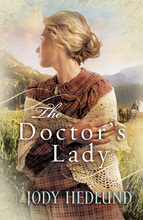
"The Doctor's Lady" by Jody Hedlund

Based on a real missionary couple of the 1830's, Jody Hedlund's novel The Doctor's Lady is the story of the journey of the first white woman to cross the Rocky Mountains.  Priscilla White has always felt called to missions, and after a severe illness left her infertile, she felt that calling reinforced.  However, the only way the missionary board will allow her to go to India - which she has long felt is her calling - is if she is married, and that, she has accepted, will never happen.  However, Dr. Elijah Ernest is also in the same predicament - except that his calling is to the Nez Perce of Oregon.  Since neither can leave without a spouse, they make a business agreement to minister to the Nez Perce together, and then embark on the arduous, seven-month journey to far Oregon - across vast wilderness no white woman has ever seen, and through land full of danger, disease, and hardship.
The Doctor's Lady
Full of real disasters and mishaps that happened to the real couple, this novel is a journey back in time to when everything west of the Mississippi was new, dangerous, and exciting, and Hedlund does not make light of the hardships or work involved in such a journey.  Even more poignant, though, is the journey Priscilla and Eli make as a couple - a journey that for them is just as new, dangerous, and exciting as their westward march, and one that is equally full of hardship and work.  The characters are not perfect, but they are so easy to like - and as such it hurts more when they are hurting, to the point where my eyes did not always remain dry. 

Both Priscilla's infertility and her loveless marriage are a burden and an embarrassment to her, so she bottles the pain inside and never speaks of it.  By never acknowledging the truth to others, she is largely able to avoid becoming an object of pity; but by not sharing it with her closest friends and family, she also misses out on the loving support they would give her - support that she has been desperately needing for so long.  It forces one to think about all the things - both big and little - one hides to avoid the pity, pain, or embarrassment that could result from sharing.  The easy excuse is that it is no one else's business, which is largely true; but the truth is that sometimes we really need support from people who love us.

As usual, Hedlund does an excellent job writing a very historical novel without compromising the story itself.  5 out of  stars!